01 Dec Proposed Language – Sections 319.010 – 319.050 in the Underground Facility Damage Prevention Act
The Honorable Jeff Myers
Missouri House of Representatives
201 West Capitol Avenue
Jefferson City, MO 65101
RE: Proposed Language – Sections 319.010 – 319.050 in the Underground Facility Damage Prevention Act
Dear Representative Myers,
My name is Sarah Magruder Lyle, and I am the Executive Director of the Damage Prevention Action Center (DPAC). I am also the President & CEO of the Common Ground Alliance (CGA). I would like to take this opportunity to thank you for your work and dedication to improving Missouri’s damage prevention laws. Missouri has shown true leadership by incorporating the Common Ground Alliance’s Best Practices into its law earlier this year.
DPAC’s mission is to advocate for public policies and industry practices that protect underground utility infrastructure and those who work and live near these important assets. DPAC works to empower elected and public officials to safeguard their communities, improve worker safety and protect critical underground infrastructure by providing the Common Ground Alliance’s data-driven resources and consensus-based Best Practices in damage prevention.
It has been brought to my attention that language has been proposed to amend section 319.015 (9), which defines the term excavation and also outlines exemptions to this definition. This language expands the types of exemptions included in the definition to include “the use of hand digging for the purpose of burying communication lines by a communications provider or their contractor when the depth is not greater than twelve (12) inches.” In addition, section 11 defines hand digging as, “any movement, placement, or removal of earth, rock, or other materials in or on the ground by use of non-mechanized tools and equipment, including, but not limited to, shovels, picks, post hole diggers, vacuum excavation, or soft digging specifically designed to excavate without damaging underground facilities.”
DPAC does not support this language, as it is contradictory to the fundamental tenants of effective damage prevention policies. DPAC does not support exempting any stakeholder or activity from contacting 811 prior to digging or being a member of the local one call center. In fact, DPAC advocates for the removal of special interest exemptions for 811 notifications, as a key policy to reducing damages.
I would like to point out the following key points:
- CGA’s Best Practices define excavation as, “ any operation using non-mechanized pr mechanized equipment, demolition or explosives in the movement of earth, rock or other material below existing grade.”
- According to the most recent CGA DIRT report, which is the only national repository of damages to all types of buried infrastructure in the U.S., no notification to the one call center is responsible for 25% of damages across the country.
- DIRT data shows that after a backhoe, handtools are the second most frequently used piece of equipment that results in a dig-in. In addition, service drops and distribution lines are the most damaged assets, in that order. As such an exemption such as this is not supported by DIRT data and we discourage these types of exemptions due to the risk involved.
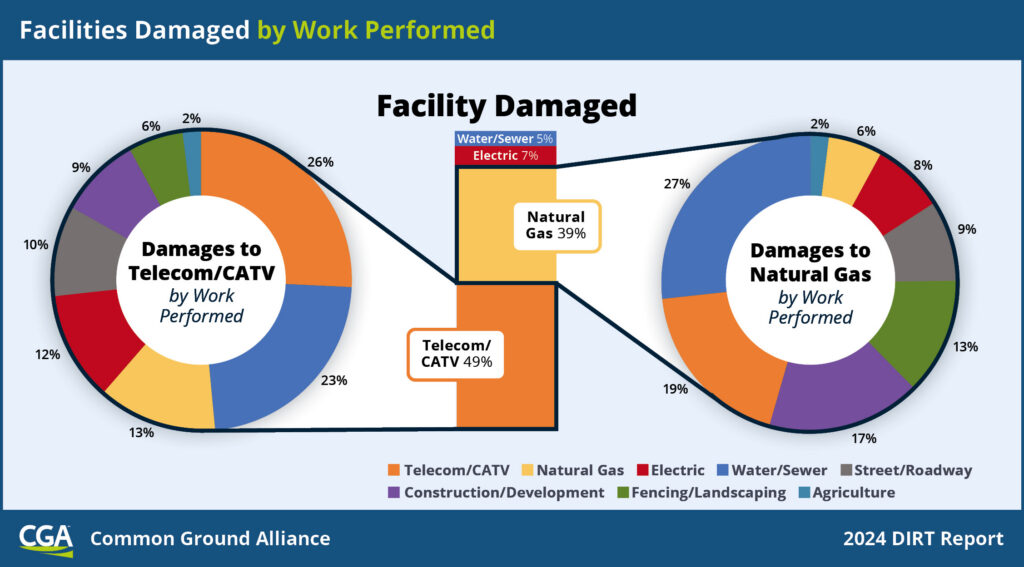
- The DIRT report also highlights that when telecom is performing telecom work, telecom facilities are damaged the most. When natural gas facilities are damaged, telecom work is the second most prevalent type of work causing damages (see chart below).
By encouraging all stakeholders to embrace CGA’s Best Practices, we will increase the resilience, safety and efficiency of our vast underground utility network.
As our Nation improves and expands its critical underground infrastructure, we appreciate Missouri’s leadership in working to improve its damage prevention laws to protect its communities and keep them safe and connected.
Sincerely,
Sarah K. Magruder Lyle
Executive Director